Static Application Security Testing (SAST) remains a foundational control for securing software development in enterprise environments. By analyzing source code without executing it, SAST tools help identify security flaws early in the development lifecycle, when remediation costs are lowest and operational traceability is strongest.
But selecting a SAST tool in an enterprise environment is not a matter of feature comparison or vulnerability counts. In enterprise contexts such as financial services, insurance, public sector, and critical infrastructure, SAST is evaluated as a governance component of the CI/CD pipeline, subject to audit, operational traceability, and policy enforcement requirements. This guide consolidates what actually drives enterprise SAST decisions in 2026: the tool landscape, a weighted RFP evaluation model with real vendor scores, a reusable scoring matrix, and a deep dive into Java-specific considerations including false-positive management.
Why SAST Still Matters in Enterprise CI/CD
CI/CD pipelines are the primary mechanism through which applications are built, tested, and deployed. Integrating SAST into these pipelines ensures that security checks are consistently applied to every code change. In enterprise contexts, SAST is not merely a developer productivity tool. It plays a key role in demonstrating secure-by-design practices, policy enforcement, and preventive controls across the delivery process.
In regulated industries, SAST also contributes to compliance by demonstrating proactive vulnerability detection and remediation. It helps enforce secure coding standards, prevents vulnerable code from reaching production, and provides measurable security metrics. However, not all SAST tools are suitable for enterprise-grade CI/CD usage. Detection capabilities alone are insufficient. Governance, scalability, evidence generation, and operational fit often determine whether a SAST solution can be safely relied upon.
What SAST Detects
SAST tools analyze source code, bytecode, or compiled artifacts to identify vulnerabilities early, without requiring a running application. Typical findings include:
- SQL injection and other injection flaws
- Cross-site scripting (XSS)
- Insecure deserialization
- Use of weak or broken cryptographic algorithms
- Hard-coded credentials
- Improper error handling and logging
These issues often map directly to well-known vulnerability categories such as the OWASP Top 10. Because SAST operates early in the development process and does not require a running application, it is particularly suitable for automated CI/CD pipelines where fast feedback is essential.
Evaluation Criteria for Enterprise SAST Tools
Enterprise SAST selection should be assessed against criteria that matter in CI/CD pipelines, rather than purely on vulnerability detection depth:
- CI/CD Integration – Native support for enterprise pipelines and automation
- Policy Enforcement – Ability to enforce security gates and quality thresholds
- Governance & Access Control – Role-based access, segregation of duties
- Evidence & Auditability – Logs, reports, and traceability usable by auditors
- Scalability – Support for large codebases and multiple teams
- Operational Overhead – Noise, false positives, and tuning effort
- Limitations – Known gaps and non-covered use cases
Most public SAST comparisons focus on the number of detected vulnerabilities, supported languages, and IDE integrations. While relevant, these criteria are insufficient for enterprise environments, where auditors, regulators, and internal risk teams expect SAST tools to enforce security policies automatically, integrate natively into CI/CD pipelines, generate audit-ready evidence, and support segregation of duties and traceability.
SAST Tool Landscape (2026)
The following vendors are the ones most frequently shortlisted in enterprise RFPs. The notes below are based on documented capabilities, public documentation, and common enterprise deployment patterns rather than vendor marketing claims.
Checkmarx (CxOne / CxSAST)
Checkmarx is a long-established enterprise SAST platform designed for large organizations with complex governance needs. It offers a balanced profile: mature policy-as-code capabilities, strong CI/CD and IDE integrations, rich reporting and audit evidence, and reasonable developer workflow support. It is often chosen when organizations want enterprise-grade SAST without extreme rigidity.
- Strengths: Mature policy-as-code, strong governance and RBAC, rich reporting, good enterprise support
- Limitations: Significant tuning effort, heavy operational footprint, slower feedback loops if not carefully integrated
- Best fit: Enterprises transitioning to DevSecOps while maintaining audit control
Fortify (OpenText)
Fortify has traditionally been positioned as a security assurance platform rather than a pure developer tool. Fortify Static Code Analyzer offers deep Java analysis of both source and bytecode, extensive rule sets aligned with industry standards, and strong reporting recognized by auditors. It is a strong choice for on-prem or hybrid deployments, deep reporting and long-term evidence retention, and mature governance workflows.
- Strengths: Strong governance and reporting, widely recognized by auditors, robust rule sets, high scalability on large monoliths
- Limitations: Less developer-friendly experience, integration complexity, longer scan times for large repositories, advanced tuning required
- Best fit: Large organizations with strict internal controls and long audit cycles
Veracode Static Analysis
Veracode offers a cloud-based SAST solution designed for scalability and ease of integration, and consistently scores as a governance and audit benchmark. It is strong in policy-based enforcement, centralized governance, audit-ready reporting, and segregation of duties. It is often selected when audit defensibility and regulatory scrutiny outweigh developer convenience.
- Strengths: Centralized, policy-driven governance, audit-ready reporting, managed platform scalability, strong CI/CD and API integration
- Limitations: Cloud-based scanning may raise data residency considerations in some production environments
- Best fit: Highly regulated enterprises (banking, insurance, critical infrastructure) and organizations preferring a SaaS AppSec platform
Snyk Code
Snyk Code targets developer-centric SAST with a focus on usability and fast feedback, integrating directly into IDEs and CI/CD pipelines. It excels in developer adoption, multi-tool integration (SCA, IaC, secrets), and fast onboarding, with ML-assisted false-positive handling.
- Strengths: Fast scans and strong developer experience, strong CI/CD integration, low barrier to adoption, broad platform coverage
- Limitations: Limited governance compared to legacy enterprise tools, audit evidence requires careful configuration, less suitable as a standalone compliance control
- Best fit: Platform-driven DevSecOps programs with moderate regulatory pressure
SonarQube (Enterprise / Security Editions)
SonarQube is widely used for code quality and maintainability, with security rules integrated into its analysis engine. While not a pure SAST tool in the traditional sense, its security rules cover many common vulnerabilities, and it is highly effective for enforcing quality and security gates in CI. It is often used as a first security gate in CI/CD pipelines, complemented by deeper SAST tools for high-risk applications.
- Strengths: Excellent developer adoption and fast feedback, tight CI/CD integration, clear issue tracking and historical trends, very high scalability
- Limitations: Not a full SAST replacement in high-risk contexts, security coverage depends heavily on rule configuration, limited audit framing out of the box
- Best fit: Engineering-centric organizations strengthening secure coding practices
Semgrep (Enterprise)
Semgrep provides customizable static analysis based on pattern matching and rule authoring, and stands out for its CI-first design, policy-as-code approach, and excellent developer feedback loops. Its governance and reporting are improving rapidly, but some enterprises may require additional evidence workflows.
- Strengths: Highly customizable rules, fast feedback loops, strong fit for modern CI/CD pipelines and policy-as-code
- Limitations: Requires strong internal expertise to govern, governance and evidence are not native, risk of inconsistency without strict processes
- Best fit: Modern engineering organizations prioritizing CI/CD enforcement and developer adoption
Comparison Summary (Enterprise Perspective)
| Tool | CI/CD Fit | Governance | Audit Evidence | Scalability | Operational Complexity |
|---|---|---|---|---|---|
| Checkmarx | Strong | Strong | Strong | High | High |
| Fortify | Moderate | Strong | Strong | High | High |
| Snyk Code | Strong | Moderate | Moderate | High | Low |
| SonarQube | Strong | Moderate | Moderate | High | Low |
| Semgrep | Strong | Weak–Mod | Weak–Mod | High | Medium |
Enterprise SAST tooling decisions are rarely based on vulnerability detection alone. Governance, scalability, and operational fit within CI/CD pipelines often play a decisive role.
RFP Evaluation: A Weighted Scoring Model
A traditional “best SAST tools” list is not enough for defensible tool selection. The following RFP-style model evaluates each vendor using a weighted scoring approach reflecting enterprise priorities, producing a comparison that procurement, security, and platform teams can defend to auditors.
Scoring Scale
- 1 — Weak / Not suitable for enterprise
- 3 — Adequate
- 5 — Best-in-class
Evaluation Categories and Weights
| Category | Weight |
|---|---|
| CI/CD Enforcement & Automation | 20% |
| Governance & Policy Enforcement | 20% |
| Evidence & Auditability | 15% |
| Developer Workflow Integration | 15% |
| Enterprise Readiness (RBAC, SSO, scale) | 15% |
| Deployment & Regulatory Constraints | 15% |
| Total | 100% |
Per-Category Vendor Scores
| Vendor | A. CI/CD enforcement (20) | B. Governance & policy (20) | C. Evidence & reporting (15) | D. Dev workflow (15) | E. Enterprise readiness (15) | F. Regulated deployment (15) | Score /100 |
|---|---|---|---|---|---|---|---|
| Veracode | 4 | 5 | 5 | 4 | 5 | 4 | 91 |
| Fortify | 3 | 5 | 5 | 3 | 5 | 5 | 90 |
| Checkmarx | 4 | 5 | 4 | 4 | 5 | 4 | 89 |
| Semgrep (Enterprise) | 5 | 4 | 4 | 5 | 4 | 3 | 82 |
| Snyk Code | 4 | 3 | 4 | 4 | 4 | 3 | 74 |
| SonarQube | 5 | 3 | 3 | 4 | 4 | 5 | 74 |
Scoring Summary
| Vendor | Final Score (/100) | Enterprise Profile |
|---|---|---|
| Veracode | 91 | Governance-first, audit-driven SAST |
| Fortify | 90 | Heavy compliance, on-prem friendly |
| Checkmarx | 89 | Strong balance governance / CI/CD |
| Semgrep (Enterprise) | 82 | CI-native, policy-as-code |
| Snyk Code | 74 | Developer-centric, platform-driven |
| SonarQube | 74 | Engineering-first, strong quality gates |
Key Observations from the RFP Model
- Enterprise SAST decisions are driven by governance, not detection alone.
- CI/CD enforcement is mandatory — tools that cannot fail pipelines are eventually bypassed.
- Audit evidence matters more than dashboards.
- Developer experience influences long-term effectiveness. A technically strong tool that developers ignore or auditors cannot validate will fail in practice.
Reusable Weighted Scoring Matrix (Per Vendor)
The applied scores above use a summary weighting. For a repeatable RFP or proof-of-concept, the criterion-level matrix below can be duplicated per vendor and scored on a 0–5 scale (0 = Not supported, 1 = Limited, 2 = Partial, 3 = Adequate, 4 = Strong, 5 = Best-in-class). This version distributes weight across seven categories.
| Category | Weight |
|---|---|
| Governance & Policy Enforcement | 20% |
| CI/CD Integration & Automation | 20% |
| Detection Quality & Accuracy | 15% |
| Developer Experience | 15% |
| Auditability & Evidence | 15% |
| Scalability & Operations | 10% |
| Vendor & Strategic Fit | 5% |
| Total | 100% |
Governance & Policy Enforcement (20%)
| # | Criterion | Score (0–5) | Weighted Score |
|---|---|---|---|
| 1 | Policy-based enforcement (block / warn / report) | ☐ | |
| 2 | Per-app / per-team policy scoping | ☐ | |
| 3 | Versioned & auditable policies | ☐ | |
| 4 | Customizable severity & rule tuning | ☐ | |
| Subtotal | /20 |
CI/CD Integration & Automation (20%)
| # | Criterion | Score | Weighted |
|---|---|---|---|
| 5 | Native CI/CD integrations (GitHub, GitLab, Jenkins…) | ☐ | |
| 6 | PR / merge-triggered scanning | ☐ | |
| 7 | Pipeline gating based on results | ☐ | |
| 8 | API / export access for results | ☐ | |
| Subtotal | /20 |
Detection Quality & Accuracy (15%)
| # | Criterion | Score | Weighted |
|---|---|---|---|
| 9 | Language & framework coverage | ☐ | |
| 10 | Low false-positive rate | ☐ | |
| 11 | Explainability of findings | ☐ | |
| Subtotal | /15 |
Developer Experience (15%)
| # | Criterion | Score | Weighted |
|---|---|---|---|
| 12 | Clear code-level findings | ☐ | |
| 13 | Actionable remediation guidance | ☐ | |
| 14 | Developer workflow integration | ☐ | |
| Subtotal | /15 |
Auditability & Evidence (15%)
| # | Criterion | Score | Weighted |
|---|---|---|---|
| 15 | Timestamped & attributable scan results | ☐ | |
| 16 | Evidence retention & export | ☐ | |
| 17 | Mapping to CWE / OWASP / compliance | ☐ | |
| Subtotal | /15 |
Scalability & Operations (10%)
| # | Criterion | Score | Weighted |
|---|---|---|---|
| 18 | Enterprise-scale performance | ☐ | |
| 19 | Centralized administration | ☐ | |
| Subtotal | /10 |
Vendor & Strategic Fit (5%)
| # | Criterion | Score | Weighted |
|---|---|---|---|
| 20 | Vendor roadmap & support | ☐ | |
| Subtotal | /5 |
Final Score Summary
| Vendor | Total Score (/100) | Risk Level | Decision |
|---|---|---|---|
| Vendor A | ☐ Low ☐ Medium ☐ High | ☐ Approve ☐ Conditional ☐ Reject | |
| Vendor B | ☐ Low ☐ Medium ☐ High | ☐ Approve ☐ Conditional ☐ Reject | |
| Vendor C | ☐ Low ☐ Medium ☐ High | ☐ Approve ☐ Conditional ☐ Reject |
Mandatory Disqualification Criteria (Hard Stops)
A vendor must be rejected if any of the following apply:
- ☐ No CI/CD pipeline gating capability
- ☐ No exportable audit evidence
- ☐ No policy-based enforcement
- ☐ No enterprise support model
- ☐ No clarity on data retention / residency
This scoring model enables defensible tool selection decisions, traceability from requirements to evaluation to selection, and reuse across future audits (ISO / SOC 2 / DORA / NIS2). Auditors typically expect documented criteria, objective scoring, and explicit acceptance of residual risks.
Java-Specific Considerations
Java remains one of the most common enterprise application stacks, and it exercises SAST tooling in specific ways. Modern Java frameworks introduce abstractions that static analysis tools must understand, and large Java codebases stress both scan performance and false-positive handling. The considerations below apply on top of the general evaluation above.
Integrating SAST into Java CI/CD Pipelines
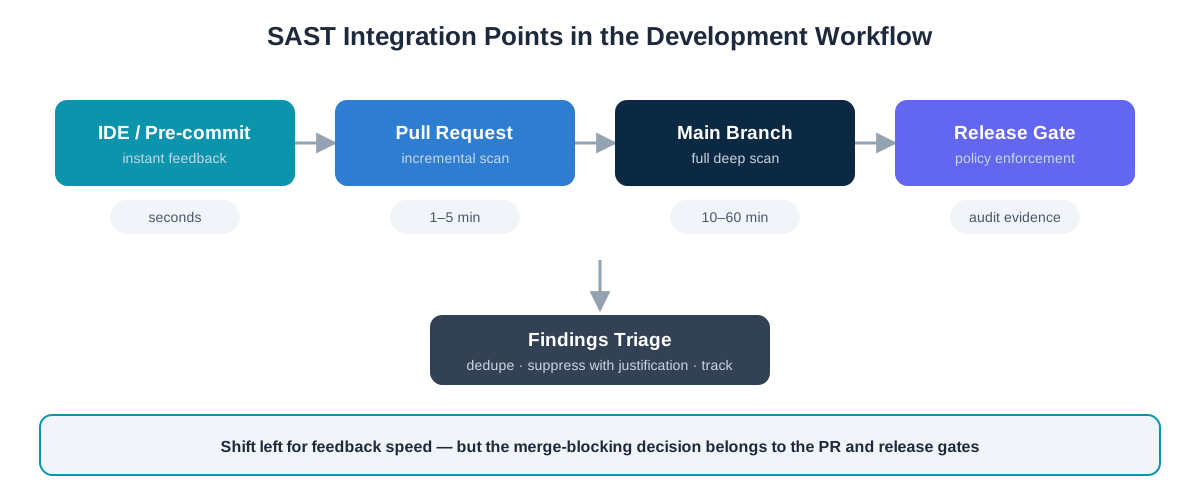
SAST is commonly integrated as an automated build step, triggered on code commits, pull requests, or scheduled builds depending on organizational policy. In enterprise pipelines it is important to balance scan depth with pipeline performance: incremental scanning, pull request analysis, and asynchronous scans reduce feedback time while maintaining coverage. Security gates can be configured to prevent builds from progressing when critical vulnerabilities are detected, while lighter or incremental scans run on pull requests. In enterprise environments, SAST is typically defined as a mandatory control within a broader CI/CD security framework that also governs access management, secrets handling, and artifact integrity.
Performance and Scalability
One of the main challenges of SAST in CI/CD pipelines is performance. Large Java codebases can lead to long scan times, which may impact developer productivity. Organizations often tune configurations, exclude non-critical code paths, and run full scans on a scheduled basis while using lighter scans for pull requests. Proper pipeline design is essential so that security does not become a bottleneck.
Results Management and Triage
SAST tools can generate a significant number of findings, and effective triage processes are required to prioritize real risks and avoid alert fatigue. In enterprise environments, results are often integrated into issue tracking systems and security dashboards, with clear ownership and remediation workflows so that findings are addressed consistently. Beyond detection capabilities, tool selection should therefore weigh reporting, access control, and long-term maintainability, since scan results, remediation actions, and policy decisions must be documented and retained as evidence of continuous security practices.
Java SAST Tools – Comparison Overview
The same vendors dominate Java-specific evaluations, but their depth and operating model differ when applied to Java source and bytecode:
| Tool | Java Analysis Depth | CI/CD Integration | Scalability | False Positive Management | Governance & Security | Typical Enterprise Use Case |
|---|---|---|---|---|---|---|
| Fortify SCA | Very deep (source & bytecode) | Strong (Jenkins, GitHub, GitLab) | High (large monoliths) | Advanced tuning required | Excellent (auditing, policies) | Large enterprises with strong AppSec teams |
| Checkmarx CxSAST | Deep (source-based) | Strong (CI/CD & IDE) | High | Good with tuning | Strong (RBAC, reporting) | Centralized AppSec programs at scale |
| SonarQube (Security) | Medium | Excellent (fast feedback) | Very high | Limited | Moderate | Early security gate in developer workflows |
| Veracode Static Analysis | Deep (cloud-based) | Strong (CI/CD & APIs) | High | Managed by platform | Excellent (security-ready) | Enterprises preferring SaaS AppSec platforms |
| Snyk Code | Medium | Excellent (IDE-first) | High | ML-assisted | Limited | Developer-driven security programs |
Tools such as Fortify and Checkmarx are often selected for their depth of analysis and governance capabilities. Developer-centric tools like SonarQube and Snyk Code prioritize fast feedback and adoption, and are frequently used as complementary controls rather than standalone enterprise SAST solutions. Cloud-based platforms such as Veracode balance depth, scalability, and operational simplicity, but may introduce data residency considerations. Rather than relying on a single tool, many organizations adopt a layered approach, integrating multiple solutions into their CI/CD pipelines for comprehensive coverage.
Managing False Positives
False positives are one of the most common challenges when implementing SAST, and they are especially acute in Java. A false positive occurs when a tool reports a security issue that does not represent a real vulnerability in the application context, often due to the limitations of static analysis, the lack of runtime context, or an incomplete understanding of application-specific controls. In Java applications, false positives are often triggered by framework abstractions, custom security layers, or defensive coding patterns that static analysis tools cannot fully interpret.
At enterprise scale, even a small false-positive rate can generate thousands of findings across large codebases. Without proper management, this volume overwhelms development teams, slows delivery, and erodes trust in the security program. Unresolved or poorly documented false positives may also create audit issues, since organizations must demonstrate that findings are reviewed and appropriately handled.
Common Sources of False Positives
- Use of modern frameworks that abstract security controls
- Custom input validation and sanitization logic
- Centralized authentication and authorization mechanisms
- Defensive coding patterns that static analysis tools cannot fully model
- Legacy code with complex control flows
Reducing, Triaging, and Governing False Positives
Reducing false positives starts with proper tool configuration: selecting appropriate rule sets, excluding non-relevant code paths, and aligning analysis settings with the technologies and frameworks in use. Regularly updating rules and keeping tools aligned with the ecosystem is essential, since outdated rule sets are a common source of unnecessary findings.
Effective management also requires structured triage workflows. Findings should be reviewed by qualified personnel who can distinguish real vulnerabilities from benign patterns, and triage decisions should be documented and tracked to ensure consistency and provide audit evidence. Clear ownership and escalation paths prevent unresolved findings from accumulating, and results are typically integrated into issue tracking systems and security dashboards.
When SAST is integrated into CI/CD, poorly configured security gates can block builds unnecessarily, leading teams to bypass or disable checks. A common approach is to use severity thresholds and staged enforcement, where only critical issues block pipelines while lower-severity findings are tracked for remediation. Suppressed or accepted findings should be justified, documented, and periodically reviewed, so that security controls remain effective and defensible over time.
Compliance & Audit Perspective
From an auditor’s standpoint, SAST tools are evaluated less on the number of findings and more on how consistently they are enforced and evidenced. Auditors typically expect:
- Documented SAST policies and thresholds
- Evidence of execution in CI/CD pipelines
- Traceability between findings, remediation, and approvals
- Historical scan results retained over time
Tools that cannot reliably produce tamper-resistant, time-stamped evidence are often considered insufficient as standalone security controls. In regulated industries, audit trails, scan reports, and remediation records support compliance with internal policies and external requirements, and SAST is frequently defined as a mandatory control within CI/CD security policies and secure software delivery frameworks.
Common Pitfalls and Anti-Patterns
- Treating SAST as a developer-only tool
- Disabling rules to reduce noise without governance
- Running scans without enforcing gates
- Retaining only the latest scan results
- Relying on SAST to cover runtime or configuration risks
These patterns often lead to a false sense of compliance and weak audit outcomes. Successful SAST adoption aligns the engineer view (fast feedback, low noise, actionable findings) with the auditor view (consistent enforcement, historical traceability, clear governance and ownership) without sacrificing one for the other.
Recommendations
There is no universally “best” SAST tool. In enterprise environments, the best tool is the one that integrates seamlessly into CI/CD, enforces security policies consistently, produces reliable audit evidence, and aligns with organizational risk management. As a rough verdict by use case:
- Best fit: Large enterprises with mature CI/CD pipelines
- Acceptable: Organizations transitioning toward enterprise environments
- Not recommended: Early-stage teams seeking lightweight security tooling, organizations without capacity to maintain rules and policies, or teams with immature pipelines and unclear security ownership
To turn this comparison into a decision, shortlist two or three vendors based on regulatory constraints, run a controlled proof-of-concept on the same repositories, and validate pipeline blocking behavior, exception workflows, and evidence export quality. Document residual risks and acceptance decisions. This approach creates a defensible audit trail for tool selection.
Tools alone do not ensure compliance. Their value depends on how they are integrated, governed, and evidenced within CI/CD pipelines.
Frequently Asked Questions
What defines a “best” SAST tool for enterprises?
The best tool balances detection, governance, scalability, and audit readiness—not just vulnerability coverage. Integration depth, policy enforcement, approval workflows, and evidence export capabilities are the key differentiators in practice.
Where should SAST run in CI/CD pipelines?
SAST should run during pull requests for early feedback and within CI/CD pipelines as an enforced control gate before release, ensuring consistency and auditability.
Is SAST mandatory for compliance frameworks?
Most frameworks do not mandate SAST explicitly, but it is widely used to demonstrate secure coding, risk management, and preventive security controls required by standards and regulations.
How do auditors assess SAST implementations?
Auditors focus on automated execution, policy enforcement, exception handling, and evidence retention rather than the individual vulnerabilities detected. Typical evidence includes CI/CD execution logs, policy configurations, approval records, historical scan results, and traceability between code changes and security checks.
Why do enterprise SAST tools look similar on paper?
Most vendors advertise similar detection capabilities but differ significantly in governance, CI/CD enforcement, and operational scalability. Detection quality matters, but governance, auditability, and operational fit usually determine long-term success.
Why use a weighted scoring matrix for SAST RFPs?
A weighted scoring matrix ensures objective comparison by prioritizing governance, CI/CD enforcement, and audit requirements over marketing claims or raw detection metrics. A standardized matrix also improves procurement consistency and reduces bias across vendor evaluations.
Are open-source SAST tools suitable for enterprises?
They can complement enterprise tools but often lack native governance, support, and evidence management features required for standalone compliance use.
How often should enterprises re-evaluate their SAST tooling?
Every 2–3 years, or whenever regulatory, CI/CD, or organizational requirements change.
How can enterprises reduce false positives in Java SAST?
Start with proper configuration (rule sets aligned to frameworks, excluding non-relevant paths), keep rules updated, and add structured triage with documented suppression decisions. Use severity thresholds and staged enforcement so only critical issues block pipelines.
Explore More on Secure Pipelines
- Complete Guide to CI/CD Pipeline Security
- CI/CD Security Scanners Compared: Trivy, Grype, Snyk, Checkov
- Secrets Management in CI/CD Pipelines
- CI/CD Policy Engines Compared: OPA, Kyverno, Sentinel, Cedar
