
Dynamic Application Security Testing (DAST) plays a critical role in securing modern enterprise applications by identifying vulnerabilities that only manifest at runtime. Unlike static analysis, DAST evaluates running applications from the outside, simulating real-world attack scenarios against web interfaces, APIs, and services deployed in staging or pre-production environments.
In enterprise and production environments, DAST is not merely a vulnerability scanning activity. It is a runtime security control that must integrate with CI/CD pipelines, respect operational constraints, and produce auditable evidence. This article is the pillar reference for enterprise DAST in 2026: it covers how DAST fits into CI/CD, the current tool landscape, a structured RFP-based selection model with weighted scoring, integration patterns, and how to manage false positives without losing audit credibility.
DAST in Enterprise and Production Environments
Enterprise applications increasingly rely on distributed architectures, APIs, cloud platforms, and third-party services. Many security issues—such as authentication flaws, access control weaknesses, and runtime misconfigurations—cannot be detected through static analysis alone. DAST addresses this gap by testing applications in execution, typically in staging or pre-production environments.
Enterprise applications commonly expose complex APIs and web interfaces, integrate multiple authentication mechanisms, operate across staging and production environments, and handle sensitive or regulated data. Against that backdrop, DAST helps identify:
- injection flaws
- authentication and session issues
- access control weaknesses
- misconfigurations visible only at runtime
Selecting a DAST tool in enterprise contexts is therefore not just a technical decision—it is also a governance, scalability, and security decision. DAST supports secure SDLC requirements, continuous security testing expectations, and the generation of evidence for runtime security validation. In practice, it must be deployed in a controlled manner to ensure scan reliability, minimal operational disruption, and consistent enforcement across delivery pipelines.
DAST vs SAST vs IAST
Each application security testing technique serves a distinct purpose within the secure software development lifecycle.
- SAST analyzes source code to identify vulnerabilities early and prevent insecure patterns before deployment.
- DAST tests running applications to uncover runtime vulnerabilities, configuration issues, and authentication flaws.
- IAST combines aspects of both by instrumenting applications during testing to provide deeper context and reduced false positives.
In enterprise CI/CD pipelines, DAST complements SAST by validating security controls in conditions that more closely resemble production. It should not be considered a replacement, but rather a critical layer in a defense-in-depth strategy that also includes SAST, SCA, and runtime protection.
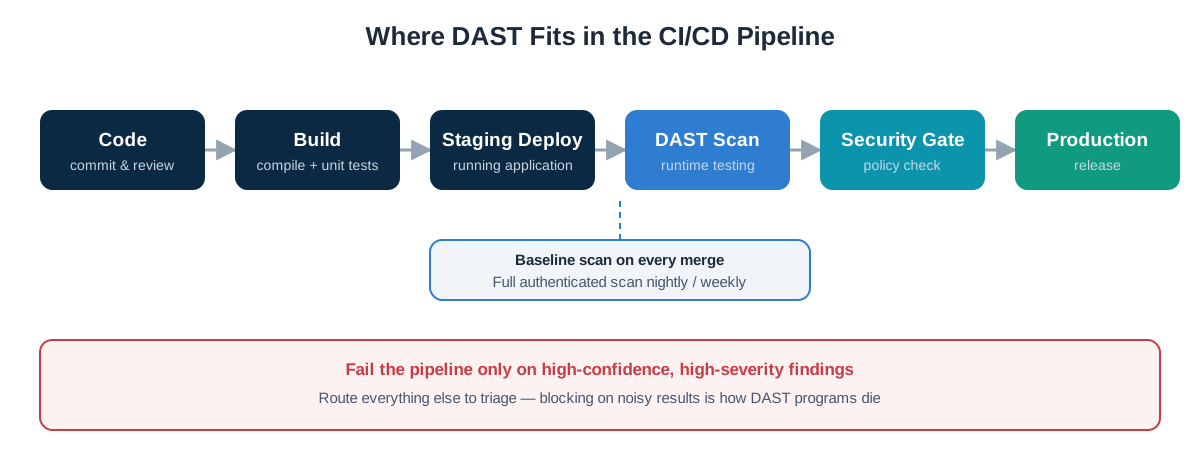
Where DAST Fits in CI/CD Pipelines
Unlike SAST, DAST introduces operational considerations such as scan duration, environment stability, and authentication handling. As a result, its placement in CI/CD pipelines requires careful design. Common integration patterns include:
- Scheduled DAST scans against stable staging environments
- Pipeline-triggered scans before release approval
- API-focused DAST integrated into automated testing phases
- Post-deployment validation in controlled environments
Enterprise pipelines typically avoid running full DAST scans on every commit. Instead, DAST is enforced at strategic points where runtime behavior can be assessed without impacting delivery velocity. Scan results should feed into CI/CD gates, vulnerability management workflows, and security reporting, rather than remaining isolated in a standalone console.
What Defines an Enterprise-Grade DAST Tool
Not all DAST tools are suitable for enterprise or production environments. Beyond vulnerability detection, enterprise-grade tools must address operational and compliance requirements. When selecting a DAST tool for enterprise use, the following criteria are often more important than raw vulnerability counts.
CI/CD Integration
- API-driven scans
- pipeline-friendly execution
- support for gated releases with deterministic exit codes
Authentication and Coverage
- support for modern authentication (OAuth2, SSO, tokens, mTLS)
- ability to test authenticated application flows
- API and microservices support
Scalability and Performance
- ability to scan large applications
- parallel execution across multiple teams and pipelines
- minimal impact on shared environments
Governance and Auditability
- scan traceability and reproducibility
- centralized reporting and policy enforcement
- historical result retention and audit-ready evidence
False Positive Management
- tuning capabilities
- issue triage workflows
- integration with defect tracking systems
Additional characteristics that distinguish enterprise-ready tools include scalable architecture supporting multiple applications, governance features for policy enforcement, and long-term vendor viability. These criteria often outweigh raw vulnerability detection metrics when selecting a DAST solution at scale.
The DAST Tool Landscape in 2026
The DAST tooling landscape has evolved significantly, with solutions addressing different enterprise needs. At a high level, tools fall into four broad categories.
Traditional Web Application Scanners
These tools focus on crawling and scanning web interfaces to identify common vulnerabilities. They are widely used but require careful tuning to manage noise and performance.
API-Focused DAST Tools
With the rise of API-driven architectures, many modern DAST tools specialize in testing REST and GraphQL endpoints, supporting authentication schemes and schema-based testing.
Cloud-Native and CI/CD-Integrated DAST
Newer solutions are designed to integrate directly into CI/CD platforms, offering automation, scalability, and policy enforcement aligned with DevSecOps practices.
Hybrid and Enterprise Platforms
Some enterprise platforms combine DAST with SAST, IAST, or runtime protection, providing centralized governance and reporting across multiple testing techniques.
Leading Enterprise DAST Tools
The following tools are commonly shortlisted in large organizations and regulated environments. Inclusion here does not imply endorsement, and exclusion does not imply unsuitability; capabilities evolve rapidly and results vary depending on organizational context, CI/CD architecture, and regulatory constraints.
PortSwigger Burp Suite Enterprise Edition
Widely adopted and well understood, often used as a baseline for authenticated web application scanning, with strong vulnerability detection and enterprise-grade automation. Enterprise considerations: it requires careful tuning for CI/CD usage, scanning large environments can be resource-intensive, and governance features depend on edition and configuration. Best suited for organizations already using Burp at scale and hybrid manual + automated testing strategies.
Invicti (formerly Netsparker)
Enterprise-focused DAST solution with a low false positive rate, strong automation, and good support for authenticated scans and CI/CD integration. Enterprise considerations: licensing and cost, and integration effort in complex CI/CD setups. Best suited for enterprises prioritizing automation, accuracy, and reliable scan results.
Checkmarx DAST
Integrated within a broader application security platform, offering unified governance, reporting, and enterprise support, and often assessed alongside SAST and SCA capabilities. Enterprise considerations: it is typically part of a larger Checkmarx ecosystem and may require platform-level adoption. Best suited for organizations standardizing on a single AppSec vendor.
Fortify WebInspect
Part of a broader application security portfolio, commonly evaluated in enterprise environments. It performs well when tightly integrated into broader governance frameworks, with strong centralized policy control, evidence retention, and audit reporting.
Rapid7 InsightAppSec
Cloud-based DAST solution frequently considered for CI/CD-native deployments. It fits CI/CD-native environments well but may need compensating controls for long-term evidence and approval workflows.
Contrast DAST / IAST-Assisted DAST
A hybrid approach combining runtime insight with dynamic testing. Effective in the right context, but it requires careful scoping to meet audit expectations, and evidence retention is more limited than dedicated enterprise scanners.
Acunetix
Mature web vulnerability scanning with good coverage for common web flaws and automation-friendly execution. Enterprise considerations: it requires tuning for modern APIs and governance features vary by edition. Best suited for web-heavy enterprise environments and teams transitioning from manual testing.
OWASP ZAP (Enterprise Usage)
Open source, highly extensible, and backed by strong community support. Enterprise considerations: it requires significant customization, governance and reporting need to be built, and false positive management is manual. Best suited for organizations with strong internal security engineering and budget-constrained environments.
Comparing Enterprise DAST Tools
| Tool | CI/CD Ready | Auth Support | Governance | Scalability | Typical Use |
|---|---|---|---|---|---|
| Burp Suite Enterprise | High | Medium | Medium | High | Hybrid testing |
| Invicti | High | High | High | High | Automated enterprise |
| Checkmarx DAST | High | High | High | High | Platform-based AppSec |
| Acunetix | Medium | Medium | Medium | Medium | Web application focus |
| OWASP ZAP | Custom | Medium | Low | Custom | Engineering-driven |
Structured Selection: RFP Weighted Scoring Matrix
Selecting a DAST tool in regulated enterprise environments is rarely a matter of choosing the solution with the most features or the highest vulnerability detection rate. In practice, DAST tooling decisions are driven by governance, CI/CD enforceability, operational reliability, and audit readiness. A weighted scoring matrix makes those priorities explicit and repeatable across vendors.
How to use this matrix
- Score each criterion from 0 to 5
- Multiply by the Weight
- Sum to obtain a Total Weighted Score
- Prioritize governance, CI/CD enforcement, and evidence over pure detection
⚠️ In enterprise environments, the highest-scoring tool is rarely the one with the most findings.
1. CI/CD Integration & Automation (Weight: 25%)
| Criterion | Description | Score (0–5) | Notes |
|---|---|---|---|
| Native CI/CD integration | Native support for GitHub Actions, GitLab CI, Jenkins, etc. | ||
| Pipeline-as-code support | DAST fully automatable via code | ||
| Deterministic exit codes | Reliable pass/fail behavior for gating | ||
| API-first architecture | Full automation via APIs | ||
| Scalability | Supports multiple teams and pipelines |
Tools that require manual execution or brittle scripting score significantly lower, as they introduce inconsistency and audit risk. In enterprise environments, CI/CD enforceability is often a hard requirement.
2. Runtime Coverage & Testing Capabilities (Weight: 20%)
| Criterion | Description | Score (0–5) | Notes |
|---|---|---|---|
| Web application scanning | Coverage of modern web stacks | ||
| API security testing | REST / GraphQL / OpenAPI support | ||
| Authenticated scanning | OAuth, SSO, mTLS, RBAC | ||
| Scan reliability | Stable scans without environment disruption | ||
| Configurable scan depth | Control over aggressiveness and scope |
Enterprise applications typically rely on authenticated workflows and APIs. Tools that struggle with authentication, session stability, or API coverage lose significant value in practice—coverage breadth alone is insufficient without reliability.
3. Governance & Policy Enforcement (Weight: 20%)
| Criterion | Description | Score (0–5) | Notes |
|---|---|---|---|
| Centralized policy management | Organization-wide DAST policies | ||
| Role-based access control | Fine-grained permissions | ||
| Exception & suppression workflows | Auditable risk acceptance | ||
| Approval workflows | Enforced approvals for releases | ||
| Cross-project visibility | Central reporting & oversight |
Governance is one of the strongest differentiators between enterprise DAST tools. Tools that treat DAST as a standalone scanner without governance capabilities score poorly in enterprise environments.
4. Evidence Generation & Audit Readiness (Weight: 20%)
| Criterion | Description | Score (0–5) | Notes |
|---|---|---|---|
| CI/CD execution logs | Traceable scan execution | ||
| Historical result retention | Long-term evidence storage | ||
| Traceability to releases | Link scans to versions/releases | ||
| Exportable audit reports | ISO / SOC / DORA-friendly | ||
| Tamper resistance | Integrity of stored evidence |
From an audit perspective, DAST tools are evaluated on process evidence, not vulnerability counts. Tools lacking built-in evidence capabilities introduce compliance gaps, even if their scanning engines are effective.
5. Operational Fit & Enterprise Readiness (Weight: 10%)
| Criterion | Description | Score (0–5) | Notes |
|---|---|---|---|
| Performance impact | Minimal impact on environments | ||
| False positive management | Noise reduction capabilities | ||
| Platform compatibility | Cloud, container, hybrid support | ||
| Vendor support & SLA | Enterprise-grade support | ||
| Cost predictability | Transparent and scalable pricing |
Operational friction—performance impact, unpredictable licensing, or weak support—is a frequent cause of DAST tool abandonment.
6. Vendor Risk & Long-Term Viability (Weight: 5%)
| Criterion | Description | Score (0–5) | Notes |
|---|---|---|---|
| Vendor maturity | Proven enterprise deployments | ||
| Security posture | Vendor security practices | ||
| Roadmap alignment | Alignment with CI/CD & cloud trends | ||
| Third-party dependencies | Transparency on sub-processors | ||
| Exit strategy | Data export & tool replacement support |
Vendor transparency, exit options, and subcontractor visibility are increasingly scrutinized under regulatory frameworks such as DORA and NIS2.
Final Scoring Summary
| Category | Weight | Weighted Score |
|---|---|---|
| CI/CD Integration & Automation | 25% | |
| Runtime Coverage | 20% | |
| Governance & Policy Enforcement | 20% | |
| Evidence & Audit Readiness | 20% | |
| Operational Fit | 10% | |
| Vendor Risk & Viability | 5% | |
| TOTAL SCORE | 100% |
Interpretation Guidance
- ≥ 80% → Enterprise & audit-ready
- 65–79% → Acceptable with compensating controls
- < 65% → High operational or security risk
A low score in Governance or Evidence should be considered a hard blocker in enterprise environments.
RFP-Based Vendor Comparison
Applying the model above to commonly shortlisted vendors produces an indicative comparison. This is intended to support RFP shortlisting and architectural decision-making, not final vendor selection, which should always be validated through proof-of-concepts aligned with your CI/CD architecture, authentication models, regulatory scope, and audit requirements.
Scoring scale
1 = Poor / Not suitable
3 = Acceptable with limitations
5 = Strong enterprise capability. Scores reflect enterprise CI/CD and audit readiness, not raw vulnerability detection.
Summary Scoring
| Vendor | CI/CD Integration | Governance & Policy | Evidence & Audit | Operational Fit | Vendor Risk | Overall Fit |
|---|---|---|---|---|---|---|
| Invicti (Netsparker) | 4.5 | 4.5 | 4.5 | 4 | 4 | High |
| Burp Suite Enterprise | 4 | 3.5 | 3.5 | 4 | 4 | Medium–High |
| Fortify WebInspect | 3.5 | 4 | 4 | 3.5 | 4 | Medium–High |
| Checkmarx DAST | 4 | 4 | 4 | 3.5 | 4 | Medium–High |
| Rapid7 InsightAppSec | 4 | 3.5 | 3.5 | 4 | 4 | Medium |
| Contrast DAST / Hybrid | 3.5 | 3.5 | 3 | 4 | 3.5 | Context-Dependent |
Interpretation Notes
- Invicti scores consistently high due to strong automation, governance, and evidence capabilities.
- Burp Suite Enterprise is powerful but often requires additional governance layers to satisfy auditors.
- Fortify WebInspect performs well in enterprise environments when tightly integrated into broader governance frameworks.
- Checkmarx DAST benefits from platform integration but may require tuning for operational stability.
- Rapid7 InsightAppSec fits CI/CD-native environments but may need compensating controls for evidence.
- Hybrid DAST / IAST approaches are effective but require careful scoping to meet audit expectations.
Governance & Evidence Deep-Dive
| Vendor | Central Policy Control | Approval Workflow | Evidence Retention | Audit Reporting |
|---|---|---|---|---|
| Invicti | Strong | Yes | Strong | Strong |
| Burp Suite Enterprise | Moderate | Limited | Moderate | Moderate |
| Fortify WebInspect | Strong | Yes | Strong | Strong |
| Checkmarx DAST | Strong | Yes | Strong | Strong |
| Rapid7 InsightAppSec | Moderate | Limited | Moderate | Moderate |
| Contrast Hybrid | Moderate | Contextual | Limited | Contextual |
These scores reflect typical enterprise RFP evaluations. Actual results may vary depending on CI/CD architecture, application stack, regulatory scope, and operational maturity, so organizations should validate assumptions through proof-of-concepts aligned with their own environments. In most enterprise evaluations, the tools that score highest are not those with the most aggressive scanning capabilities, but those that excel in governance, automation, and evidence generation. A low score in governance or audit readiness should be treated as a potential blocker regardless of detection performance.
Governance and Policy Enforcement
In enterprise environments, DAST must operate under clear governance rules. This includes defining when scans are mandatory, which vulnerabilities block releases, and how exceptions are handled. Key governance aspects include:
- Centralized definition of DAST policies
- Role-based access control
- Controlled handling of false positives and suppressions
- Approval workflows for risk acceptance
- Consistent enforcement across teams and applications
Without governance, DAST risks becoming an advisory tool rather than an enforceable security control.
Evidence and Audit Considerations
One of the primary differences between enterprise-grade DAST and ad-hoc scanning lies in evidence generation. Auditors typically do not review individual vulnerabilities; instead, they assess whether DAST is executed consistently and whether its results are traceable and retained. Enterprise DAST tooling should support:
- Automated execution logs tied to CI/CD runs
- Historical scan results with retention policies
- Traceability between releases and security scans
- Exportable reports suitable for audit reviews
These capabilities are essential for demonstrating compliance with frameworks such as ISO 27001, SOC 2, DORA, NIS2, and PCI DSS.
Managing False Positives in Enterprise DAST Pipelines
Without a disciplined approach to false positives, DAST can quickly become a source of noise, friction, and audit risk rather than a reliable security signal. Managing false positives well preserves security value, supports delivery velocity, and remains defensible during audits.
Why False Positives Are a Bigger Problem in DAST Than They Appear
Unlike SAST, which analyzes source code deterministically, DAST operates by interacting with running applications. This introduces inherent variability in authentication state, environment configuration, data dependencies, and timing or scan stability. As a result, DAST findings can fluctuate between scans, producing results that are technically valid in one context but irrelevant or non-exploitable in another. In enterprise environments, the problem is not just developer frustration: uncontrolled false positives undermine trust in security controls and weaken audit credibility.
Noise vs Signal: Reframing the Problem
The core issue is not “false positives” versus “true positives”, but noise versus signal.
- Signal: findings that are reproducible, relevant to the production threat model, and actionable.
- Noise: findings that cannot be reproduced, are context-dependent, or provide no meaningful risk reduction.
Enterprise DAST programs succeed when they optimize for signal quality, not raw vulnerability counts. Auditors rarely ask “How many vulnerabilities did your DAST tool find?” They ask “How do you ensure your security testing results are reliable, reviewed, and governed?”
Suppression Is a Control, Not a Shortcut
Suppressing a DAST finding is a risk decision, not a technical tweak. In enterprise environments, every suppression must be deliberate, justified, reviewable, and reversible. Ad-hoc suppression by developers or pipeline engineers is a red flag during audits.
1. Risk-Accepted Suppression
The finding is acknowledged, reviewed, and explicitly accepted based on risk analysis. Required elements: justification, approving role (security / risk), scope (application, endpoint), and an expiration or review date.
2. Context-Based Suppression
The finding is valid in theory but not exploitable due to architectural or runtime controls (e.g., WAF, strong auth, network isolation). Key requirement: a documented dependency on compensating controls.
3. Environmental Suppression
The finding is only relevant in non-production environments (test data, mock endpoints). Critical rule: suppressions must never silently propagate to production scans.
Scan Stability: The Hidden Driver of False Positives
Many false positives are not vulnerabilities—they are scan instability artifacts. Common causes include inconsistent authentication handling, expiring tokens or sessions, rate limiting or anti-automation defenses, dynamic content generation, and parallel scan execution across environments.
Enterprise pipelines should treat DAST scans as repeatable test executions, not ad-hoc probes. Best practices include:
- dedicated scan accounts with stable credentials,
- deterministic scan configurations,
- controlled scan scheduling,
- separation between discovery and attack phases,
- versioned scan profiles.
A stable scan baseline dramatically reduces false positives before any suppression is needed.
Audit Impact and CI/CD Gating
From an audit perspective, the most dangerous pattern is not having false positives—it is having ungoverned suppressions. Auditors typically ask who can suppress a DAST finding, how that decision is reviewed, whether the suppression is permanent or time-bound, and whether suppressed findings can be retrieved and re-evaluated. To remain defensible, organizations should be able to produce a suppression policy, role-based access controls for suppression actions, audit logs of suppressions and approvals, evidence of periodic review, and linkage between suppressions and risk decisions.
False positive management must also be tightly integrated with pipeline gating logic. Anti-patterns include blocking builds on unreviewed DAST findings, blanket “ignore all” rules to unblock delivery, and manual overrides without evidence. The recommended approach is to allow conditional pass based on approved suppressions, enforce re-validation on major releases, and require security approval for permanent suppressions. This preserves delivery velocity while maintaining audit integrity.
Common Pitfalls in Enterprise DAST Implementations
Many organizations struggle with DAST adoption due to unrealistic expectations or poor integration. Common challenges include:
- running DAST too late in the lifecycle
- lack of authentication coverage
- excessive false positives without triage processes
- scanning production without proper safeguards
- unstable scans and lack of ownership between security and engineering teams
- treating DAST as a one-time assessment rather than a continuous control
These issues often lead to limited adoption, tool rejection, or audit findings. Successful enterprise implementations align DAST with delivery workflows and operational realities rather than treating it as a purely security-driven initiative.
Recommendations and Key Takeaways
- In 2026, effective DAST tooling is defined less by detection capabilities and more by integration, governance, and audit readiness.
- Use a weighted scoring matrix to keep selection objective, and treat a low score in governance or evidence as a hard blocker regardless of detection performance.
- Validate any shortlist through proof-of-concepts aligned with your CI/CD architecture, authentication models, and regulatory scope. A full RFP-style evaluation is typically revisited every 2–3 years, or sooner when CI/CD architectures change or audit findings highlight gaps.
- False positives are inevitable, but unmanaged false positives are a governance failure. Optimize for signal quality, keep suppression governed and reversible, and improve scan stability before reaching for suppression rules.
- Treat DAST as one layer of a broader DevSecOps strategy alongside SAST, SCA, and runtime protection—not a standalone scanner.
By selecting and integrating DAST tools thoughtfully, organizations can strengthen runtime security, reduce operational risk, and demonstrate continuous compliance without compromising delivery velocity.
Frequently Asked Questions
What is DAST in an enterprise security context?
Dynamic Application Security Testing (DAST) evaluates running applications to identify runtime vulnerabilities such as authentication flaws, access control issues, and misconfigurations. In enterprise environments, DAST acts as a controlled runtime security validation within CI/CD pipelines.
Where should DAST be executed in CI/CD pipelines?
DAST is typically executed against stable staging or pre-production environments, either as a scheduled scan or as a gated step before release approval. Running DAST on every commit is rarely practical at scale.
How does DAST complement SAST and IAST?
SAST identifies issues in source code, while DAST detects vulnerabilities that only appear at runtime. IAST provides deeper context during testing. Together, these techniques form a layered application security strategy.
Is DAST required for compliance frameworks?
Most frameworks do not explicitly mandate DAST, but it is commonly used to demonstrate runtime security testing, vulnerability management, and operational risk controls required by standards such as ISO 27001, SOC 2, DORA, NIS2, and PCI DSS.
Why is a weighted scoring matrix necessary for DAST RFPs?
A weighted scoring matrix ensures that enterprise DAST selections prioritize CI/CD enforcement, governance, and audit readiness rather than vendor marketing claims or raw vulnerability counts. Using a standardized matrix also improves procurement consistency and enables fair comparison across vendors.
Why are vulnerability detection rates not the primary ranking factor?
In enterprise environments, auditors and risk committees do not assess DAST effectiveness based solely on the number of vulnerabilities detected. They evaluate execution consistency, policy enforcement, traceability, and evidence retention, which are the primary focus of enterprise evaluation.
Are these scores sufficient to select a DAST tool?
No. The scoring tables are intended for shortlisting and architectural decision-making, not final vendor selection. Organizations should validate shortlisted tools through proof-of-concepts aligned with their CI/CD pipelines, authentication models, and audit requirements.
Are false positives unavoidable in DAST tools?
Yes. Because DAST interacts with running applications, factors such as authentication state, environment configuration, and runtime behavior inevitably produce findings that are not exploitable in practice. The goal is not zero false positives, but controlled and explainable results.
Who should be allowed to suppress DAST findings?
Suppressions should be restricted to defined roles (security, risk, or platform governance teams). Developers may propose suppressions, but final approval should be role-based and auditable. Uncontrolled suppression is commonly flagged by auditors as a governance weakness.
How should false positives be handled in CI/CD gating?
Enterprise pipelines should allow conditional pass based on approved suppressions, enforce re-validation on major releases, and prevent permanent suppressions without periodic review. This balances delivery speed with audit defensibility.
Related Articles
- Complete Guide to CI/CD Pipeline Security — End-to-end reference for securing delivery pipelines
- Best SAST Tools for Enterprise CI/CD Pipelines (2026 Edition) — Companion pillar covering static analysis
- CI/CD Security Scanners Compared: Trivy, Grype, Snyk, Checkov — Comparative analysis of container and infrastructure scanners
- How Auditors Actually Review DAST Controls in Enterprise Environments — Real audit expectations for DAST controls
- Why Most DAST Implementations Fail in Enterprise Environments — Common failure patterns and anti-patterns
